Leaflets and postcards
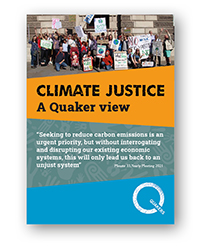
Climate justice: A Quaker view
This short, 4-page leaflet describes why climate justice is important to Quakers and what campaigns we are currently focusing on. Quaker testimonies are not a form of words, but a way of life, arising from our experience that there is something of God in everybody. These principles are the basis for Quakers' work on climate justice and on many other linked areas of concern.
Download
Climate justice: A Quaker view (PDF, 2.1MB)
Order hard copies through the order form.
Taking action on climate justice
This action guide offers an introduction to climate justice and explores what climate campaigners in the UK are focusing on. It also outlines how some Quakers are taking action and suggests some ways to get involved. Quakers have long understood that this violence against people and planet is driven by an exploitative economic system that puts profit above all else. That's why the climate work of Quakers in Britain focuses on justice.
Download Taking action on climate justice (PDF, 7.8MB)
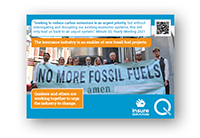
Insure our future postcard
Insure Our Future is a coalition asking insurers to stop offering insurance to new coal, oil and gas projects, particularly those with poor implications for human rights. For a safe and liveable future, we need to stop embarking on new fossil fuel projects like oil fields and coal mines. The insurance industry could play an important role in this change by refusing to insure oil and gas. More information available on the Current climate justice campaigns page.
Download
Insure our future postcard (PDF, 2.8MB)
Order physical copies by emailing qpsw@quaker.org.uk.
Order hard copies through the
order form.
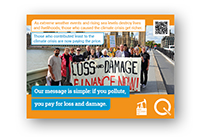
Make polluters pay postcard
As extreme weather events and rising sea levels destroy lives and livelihoods, those who caused the climate crisis get richer. Those who contributed least to the climate crisis pay the price. We work with faith groups and NGOs to call on the UK government to help identify sources of finance for loss and damage, as part of the Make Polluters Pay. These postcards can be used at vigils or for letter writing to your MP.
Download
Make polluters pay postcard (PDF, 2.7MB)
Order physical copies by emailing
qpsw@quaker.org.uk.
Order hard copies through the
order form.
Exploring faith and climate justice course
The Exploring Faith and Climate Justice course, co-developed by Woodbrooke and Quakers in Britain, created a series of workbooks to be used in Quaker Communities as a self-guided group study. Please refer to this useful Climate justice glossary (PDF) if you are unfamiliar with any of the terms included in the course. Please let us know how you've used these resources and share your feedback.
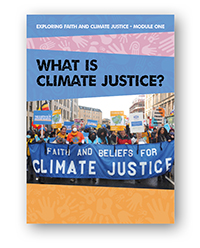
Module 1: What is climate justice?
This first booklet defines climate justice. It's a term that is increasingly used, but one that is not so well understood. It challenges our status quo and imagines a different world – a world in which we recognise and address the inequalities and power imbalances that have led us here; in which we repair the harm we have done to one another and to the planet, and build a more sustainable, loving system of organising ourselves.
Download Module 1: What is climate justice? (PDF, 7.4MB)
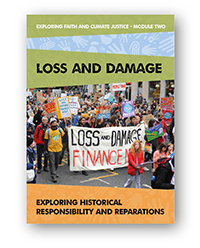
Module 2: Loss and damage: exploring historical responsibility and reparations
Having explored the meaning and origins of climate justice in Module 1, we move on to explore two key concepts: historical responsibility and reparations. We are explore them through the lens of a particular climate justice issue – climate change-induced 'loss and damage'. Loss and damage helps us to understand why wealthy nations owe a huge 'climate debt', as well as how we might begin to repair the harm we have done.
Download Module 2: Loss and damage: exploring historical responsibility and reparations (PDF, 4.1MB)
Module 3: Climate justice and the new economy
The climate crisis is a crisis of production and consumption – how much 'stuff' we produce, use and throw away, how much energy we use and where we get it from. “The environmental crisis is enmeshed with global economic injustice" (Minute 36, Yearly Meeting 2011). These twin crises are not an inevitable result of human nature: both result from a particular economic system based on extraction and exploitation.
Download Module 3: Climate justice and the new economy (PDF 3.6MB)
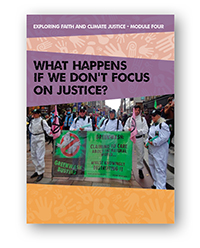
Module 4: What happens if we don't focus on justice?
Those of us who seek to build a just and peaceful world must be alert to the tactics and narratives used by those who are pursuing a very different agenda. We should be careful to examine policies and language around climate and ask ourselves whether they are truly part of the world we want to build. This module explores 'false solutions' which claim to be addressing the climate crisis, but often make the problem worse, harming communities and habitats.
Download Module 4: What happens if we don't focus on justice? (PDF 3.5MB)

Module 5: Living in right relationship with the Earth
When it comes to our relationship with the rest of the living world, there are many places to find joy and inspiration. We explore some of them in this booklet. For example, in the UK, people are carving out space for regenerative farming and nature education. Environmental defenders around the world are protecting ecosystems. And in some communities, traditional ways of relating to the rest of the living world are being kept alive or restored.
Download Module 5: Living in right relationship with the Earth (PDF 2.8MB)
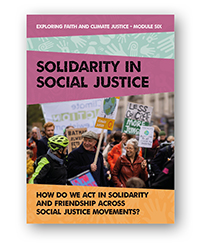
Module 6: Solidarity in social justice
This is the sixth and final booklet in our series. How do we build an effective mass movement of people for climate justice, and win a future where all of us can survive and thrive? No one has the answers. We've never done anything quite like this before. However, our experience as Quakers has taught us that we are stronger when we build alliances – and that love, friendship and solidarity must be the foundation of our work.
Download Module 6: Solidarity in social justice (PDF 3.3MB)
Further resources
Britain's summer heatwave – 2026
The long, hot summer drought of 2026 with its wildfires and record heat made the climate emergency feel personal for many people in Britain.
This document is a short list of talking points, quotes and statistics to use to remind people about it.
It may be helpful in all our conversations about climate in any context, as well as our own reflections on climate justice.
Download Britain's summer heatwave – 2026 (PDF)
Tax and climate justice – 2026
This article was written in its original form for the Quaker Peace & Social Witness Central Committee, which considered it in November 2025 and suggested that it be shared more widely. It focuses on tax in the context of the climate crisis but may also be relevant to issues such as the growth of militarism. It deals with tax policy rather than individual or corporate responsibility, using our Quaker perspectives and experience to set out six guiding policy principles.
Download Tax and climate justice (PDF)
Canterbury Commitment to becoming a low-carbon community – October 2011
At the Yearly Meeting of the Religious Society of Friends (Quakers) in Britain in Canterbury at the University of Kent in 2011, Friends agreed a meaningful minute, now known as the Canterbury Commitment. It issued a clear call to action to consider the effect of our lives on the world's limited resources. It ends with the assertion that “above all that, Friends keep in their hearts that this action must flow from nowhere but love."
Download Canterbury Commitment to becoming a low-carbon community – October 2011 (PDF)
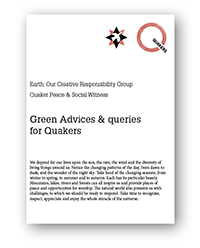
Green advices & queries – 2002
Alongside the Quaker Advice and Queries, these Green advices and queries can be used for individual or collective reflection. We depend for our lives upon the sun, the rain, the wind and the diversity of living things around us. These prompts remind us to notice the changing patterns of the day, from dawn to dusk, and the wonder of the night sky, to take time to recognise, respect, appreciate and enjoy the whole miracle of the universe.
Download Green advices & queries – 2002 (PDF)
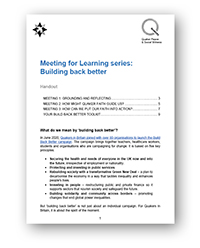
Build Back Better – 2020
After the Covid pandemic, Quakers joined a campaign for a green and just recovery. The campaign sought to secure the health and needs of everyone in the U and to rebuild society with a plan to decarbonise the economy in a way that tackles inequality and enhances people's lives. This resource includes sessions plans and worship sharing guides that may still be relevant for Quaker Meetings considering how to work for local and national change.
Download Build Back Better – 2020 (PDF)