Santa Marta and the great transition away from fossil fuels
Ben Niblett shares why he's celebrating the conference on the transition away from fossil fuels, with coffee and stroopwafels.
The Santa Marta conference opens in Colombia on Friday 24 April. I was glad when it was announced at the end of the COP30 climate talks in Brazil, last November, as a way for countries that are serious about getting off fossil fuels quickly and fairly to plan how to do it together – without getting bogged down at COP with the likes of Russia and Saudi Arabia. It'll report back to COP but offers a faster path.
It starts with gathering ideas from civil society, academic, indigenous, private sector, local government and other groups. Then the ideas all go into the 'high level segment' on 28-29 April with national and local government leaders to turn into plans. It's jointly organised by the Colombian and Dutch governments, and held symbolically in the coal port city of Santa Marta. There are plans for a follow up gathering later this year.
Faith leaders spoke up
Quakers in Britain signed a joint Santa Marta letter from faith leaders to Ed Miliband. Faith for the Climate Chair, Giles Goddard, said "It's really important that the UK continues its record of climate leadership by working with climate allies. In the face of a fossil fuel crisis, this conference is vital to accelerate the transition away from fossil fuels, and ensure that it is fast, fair and funded.
"Ed Miliband's attendance would show the UK is serious about climate justice and wants to work together, especially with the countries most impacted by the climate crisis. As Ed said himself, 'You can't solve a fossil fuel crisis by doubling down on fossil fuels.' Santa Marta is a key opportunity to bring on 'the era of clean energy security.'"
I'm glad the government are going to the conference, but it's a pity there's no minister going at the moment.
Better and worse
Britain is doing well in some ways on a just transition away from fossil fuels, like this government's ban on new oil and gas exploration, and closing our last coal power station two years ago. We're going backwards in others, like halving our climate finance, money to help communities adapt to more fires, floods, and droughts, and find clean ways to develop. Scotland has a small but groundbreaking climate justice fund as a first step towards addressing the damage that can't be adapted to, but there's no funding like that at UK level.
I remember talking to an Indigenous theologian named Jocabed Solano, hearing the story of her Guna people finding life harder on their archipelago of islands between Colombia and Panama as the sea rises and the seasons get unpredictable. They're working out how to keep their culture alive – and where they can go – if they have to move to the mainland. Several nations attending Santa Marta are small island states especially at risk from climate change, such as Fiji and Jamaica. Others are major fossil fuel producers, including Colombia itself, as well as Australia, Brazil, Canada and Norway.
Climate justice is urgent – the people who benefited the least from the fossil-fuel era are now suffering the most, in countries made vulnerable to the climate crisis by years of colonialism, not just by geography. The Quaker faith is rooted in a belief in the humanity and equality of all people. We are therefore called to address the injustice of the climate crisis, and to build a new world rooted in climate justice, and our climate justice resources help us to do that.
Joy of cooperation
There's always something wonderful about international cooperation. In times like these when multilateralism is retreating and selfish nationalism advancing, working together across countries and continents is more beautiful than ever. The Santa Marta conference is a great example of hope and courage, of national governments, indigenous peoples, faith groups, academics and civil society daring to spell out what the world needs and plan how to get there together, with justice.
Vigils of support
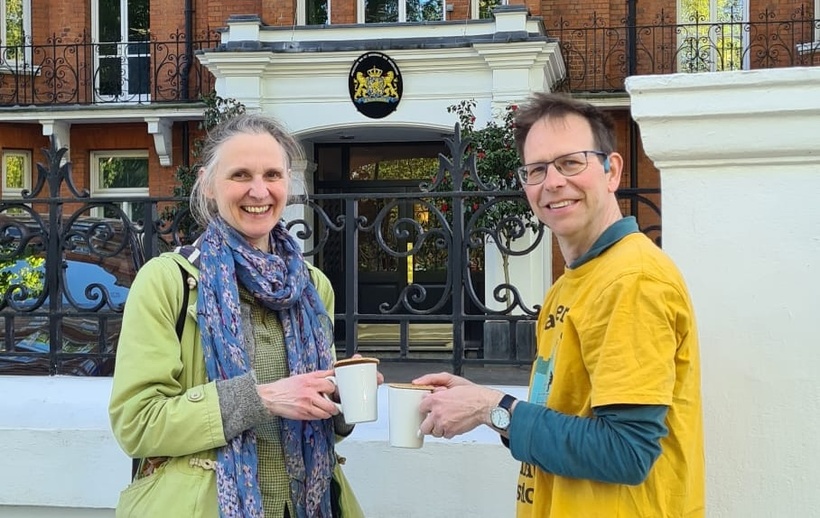
Quakers in Britain and other members of Faith for the Climate are holding interfaith vigils at the Colombian and Dutch embassies in London, on Friday 24 April and Wednesday 29 April to mark the opening and closing of the conference, in solidarity with civil society in Santa Marta, and campaign events around the world. They are to encourage and thank the Colombian and Dutch governments for organising the conference.
I tend to use food as a symbol, so as this is a Colombian and Dutch led initiative, it makes me think of dipping a Dutch stroopwafel in a cup of Colombian coffee as a tiny reminder that good things happen when we combine different countries' contributions. I'll bring some to the vigils.
Vigil details:
Opening vigil | Friday 24 April
3.30pm Colombian Embassy, 3 Hans Cres, London SW1X 0LN. Behind Harrods. Nearest underground Knightsbridge (the underground strike is due to finish at noon, but there will be disruption).
4.00pm Walk between embassies, or bus along Kensington Road.
4.30pm Netherlands Embassy. 38 Hyde Park Gate, South Kensington, London SW7 5DP. Opposite Hyde Park. Nearest underground Gloucester Road.
Closing vigil | Wednesday 29 April
1.30pm Colombian Embassy, 3 Hans Cres, London SW1X 0LN. Behind Harrods. Nearest underground Knightsbridge.
2.00pm Walk between embassies, or bus along Kensington Road.
2.30pm Netherlands Embassy. 38 Hyde Park Gate, South Kensington, London SW7 5DP. Opposite Hyde Park. Nearest underground Gloucester Road.
Everyone is welcome at any of the vigils – please email climatejustice@quaker.org.uk if you'd like any more information.