Overheating and planning for the new reality
Ben Niblett explores what will be necessary to handle future heatwaves.
We've never had a summer like this before.
This is the first year it's reached 35 degrees in May, and June and again in July in Britain. How are we coping?
I'm well looked after working in Friends House, the central offices of Quakers in Britain. One of the air conditioned conference rooms is a cool room staff can use, and as central London swelters, stepping into it is blissful. This particular room was named after George Bradshaw, the 19th century Friend who “made railway time-tables to the glory of God" as the display board puts it.
There was another rail connection that day, as I saw Eurostar order new trains that can handle 55 degree heat, which they called a 'Saudi summer'. They're future proofing for trains that might last 30 years and the worst scenario of how hot it could get.
At the moment I'm not really future proofed, except when I'm at Friends House. My house is cool downstairs, with fans on, but upstairs it's been too hot to work or think straight for most of the day, it feels like we're hiding in a cave behind closed curtains, and it's hard to get to sleep. We don't have aircon, or passive cooling systems, because nobody thought of putting aircon into homes in Britain till very recently. It wasn't hot enough to need it till we changed the climate.
My parents are in their 80s and I worry about them overheating. Their kitchen stays cool, but they don't want to spend all day in the kitchen. Nor do they want to use fans (because they look ugly) or limit their gardening to dawn and dusk (because the garden must look beautiful). I'm glad my kids are fully grown and I'm not trying to keep babies cool, or look after them and a friend or two if their school shuts unexpectedly.
Looking up
Looking up from me and my family, this long hot summer reminds Britain climate change is upon us now. I hope it cuts through the urgency-sapping feeling that it's a distant issue affecting distant people and our distant future, but not us today. May and June's heatwaves contributed to the deaths of 2,700 people in Britain. We've seen wildfires across Britain, made worse by wetter winters meaning more vegetation grows, and hotter summers drying it out and making it more flammable. We've had travel warnings and cancelled trains.
Looking round
Helping our communities plan for heatwaves is one of the best things we can do. Sharing cooling tips, staying in touch with neighbours, friends and Friends, setting up cool hubs – these are all community plans we'll need more often, in the same way many places already do for warm hubs, and floods. Many more communities will have to.
Going deeper
If you want to go deeper, the Climate Change Committee timed it perfectly with their report in May on how Britain can adapt from now to 2050 as the climate changes. It's a manageable amount of investment, and popular, but we really need to accept that it's vital and crack on with it. If you want more than that, Carbon Brief's summary does it well. Food, transport, buildings, schools, hospitals, prisons, workplaces, it's all in there.
Sharing resources
Britain is a rich country, though of course we don't share it fairly, with far more resources than many to cope with heatwaves and wildfires. We were the first country to burn fossil fuels at scale in the industrial revolution, and we're still one of the biggest historic emitters. So the promises we made to fund countries and communities who did much less damage and have much less resource – often because of a colonial history which Britain also dominated – were welcome.
Sadly the outgoing Prime Minister chose to cut Britain's climate finance and spend it on weaponry instead. We'll be calling the new ministers to reverse that and fund vulnerable communities inside and outside the UK to adapt to the heat.
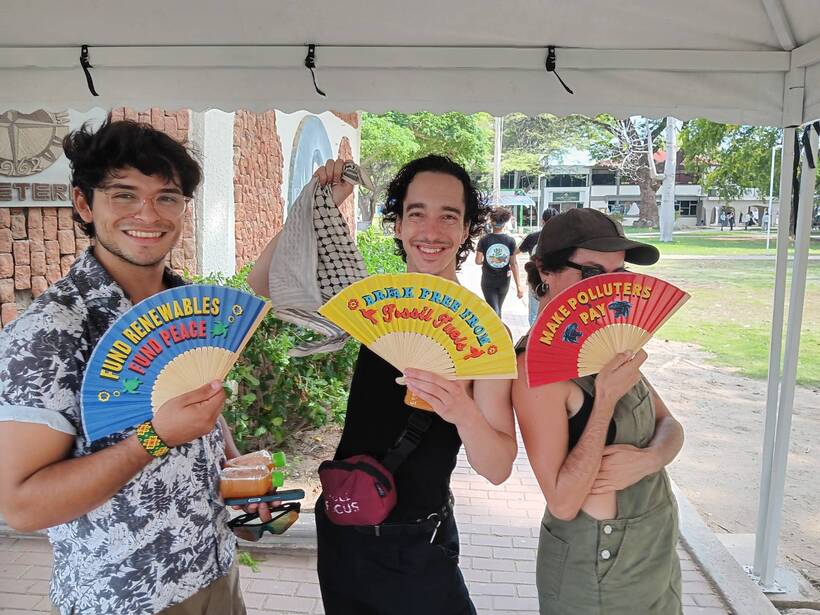
In the same way we'll also keep working with Make Polluters Pay for the big fossil fuel companies to pay their share for the damage they've caused. One of my favourite ways to keep cool is the Make Polluters Pay fan, given to overheating delegates at the recent conference for the Transition Away from Fossil Fuels, in Colombia.
National Emergency Briefing
As the heatwaves drag on across the UK, the National Emergency Briefing is resonating with people. Launched in April, the film is 45 minutes long, with experts taking us through the climate emergency, and ordinary people's reactions (like Gogglebox). I love the film and its momentum. Quakers and many others have hosted thousands of screenings in communities and workplaces, getting up to speed and planning what to do together.
Visit www.nebriefing.org to sign their petition, find a screening or say you're interested in hosting one.
Sign the National Emergency Briefing petition or host a screening