Do Quakers still exist?
The Quaker movement started in the seventeenth century and is often first encountered in history books: moving to North America in search of religious freedom, for example. Rhiannon Grant shares how Quakers are thriving today.
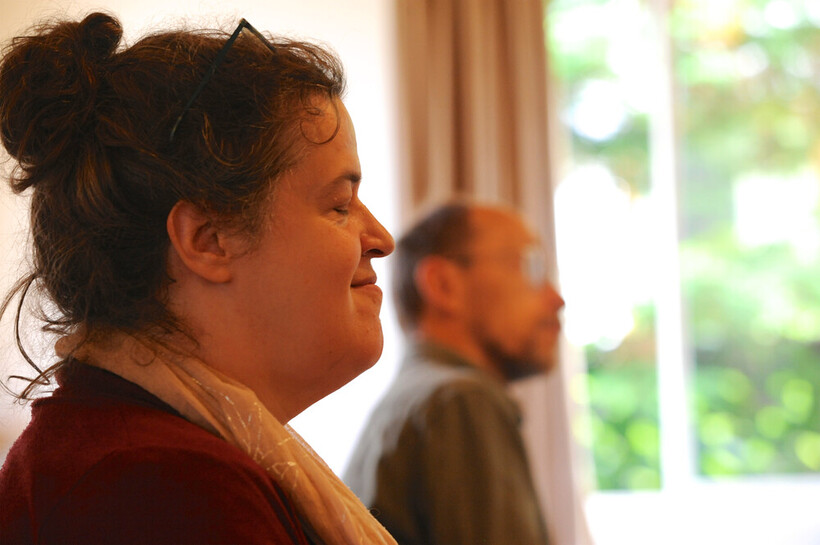
Quakers very much exist today. Personally, I don't usually have to say so: I'm a Quaker, many of my family and friends are Quakers, I worship in a Quaker meeting, and I work for a Quaker organisation, so it's too obvious to mention in most of my life. But it's a very reasonable question if you've only encountered Quakers in history.
If you've come here from an internet search or AI conversation, or if you already know a bit about Quakers and are interested to learn more, here are my four top pieces of evidence that Quakers not only exist today but are thriving.
1. Quakers exist in historic heartlands and around the world
As those history books may have told you, the Quaker movement began in the north of England in 1652, centred on a direct experience of the divine and a willingness to throw out rituals which didn't feel authentic. From there, it spread throughout England and Wales, into Scotland, Ireland, and across Europe, to colonies in the Americas, and around the world – sometimes through Spirit-led preaching, and sometimes through mission or the mechanisms of empire.
Quakers still care for and worship in many of these places with rich histories. For example, in Britain you can visit Swarthmoor Hall, home of the 'mother of Quakerism', Margaret Fell. In the Quaker-founded state of Pennsylvania, Arch Street Meeting House is both a historic site and museum and hosts an active worshipping community.
But Quakerism didn't stop growing. Today, there are Quakers in every inhabited continent, with notable Quaker communities – some large, some small, all seeking to bring God's love into the world through their worship and actions – in Australia, Bolivia, Kenya, South Korea, Zimbabwe, and many other places. A total of 87 countries at last count.
2. Quakers have a deep and living spirituality
Direct experience of the divine isn't a thing of the past. In Quaker worship today, people set out to listen to God speaking to them, receive guidance, and test it with their communities to find a right way forward. That can look different in different Quaker communities. Our diversity includes worship which is mostly silent and worship with songs and talks, worship in purpose-built or adapted spaces, worship online, worship at home and outdoors and in hospitals or wherever we find ourselves.
However we worship, the core Quaker idea is that we need only to turn inwards, where that of God within is always with us. Quakers might call this the Inner Light, the Spirit, or Love. Quaker experience, over almost four hundred years, is that when we get together and pay attention this Inner Light leads us both spiritually and morally.
3. Quakers speak out on political issues
Often Quakers are led to take action, including through campaigning and political involvement, to create a more just and peaceful world. That means responding to situations as they arise – some now get mentioned in history books, like the work of the Friends Ambulance Unit (PDF).
More recent and ongoing examples include work to prevent election violence, maintain religious freedom, train peer mediators, make polluters pay, celebrate truth and integrity in public life, support people affected by homelessness and poverty, and thousands of other projects.
4. You can check for yourself
If you'd like to know more about Quakers, why not check on our existence for yourself? Quakerism is an experimental faith and values personal experiences, so we welcome people who just want to try it out. I'm often surprised by how much I can learn from the stillness of meeting for worship.
You could find a Quaker community in Britain or elsewhere in the world, read a leaflet about what it's like to go to a Quaker meeting for the first time, try online worship like that run by Woodbrooke, or join a discussion group offered by Discovering Quakers.