A disowned prophet: learning about Benjamin Lay
Susan Seymour reviews the film Becoming Benjamin Lay, as well as other recent work on this radical prophet who was disowned but is now being reclaimed.
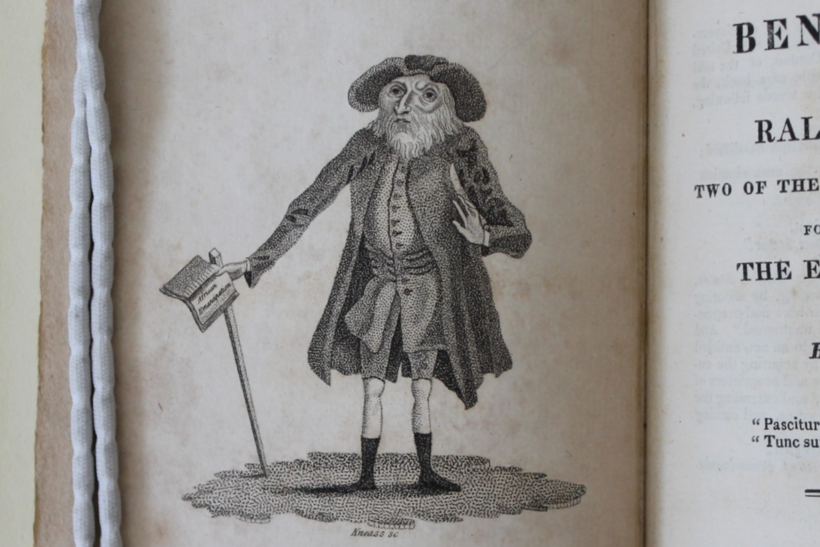
If you have visited Friends House in Euston, you may have been in the Benjamin Lay conference rooms. They have not been there for long, which matches the reality that this outspoken, eccentric dwarf is a long-forgotten Quaker prophet who, as prophets do, made people most uncomfortable. In his case, it was the Friends in the early eighteenth century enriching themselves from the transatlantic economy based on chattel slavery who were upset. He was one of the first abolitionists calling for the complete eradication of the enslavement of people.
One of the Benjamin Lay rooms was full of Quakers and others in April to see the film Becoming Benjamin Lay. It follows on from a play which I had the privilege of seeing at a small theatre in West London back in 2023, The Return of Benjamin Lay. The film is not a recording of the play, although it has extracts from it, but is about the making of the play and a further performance at a conference of the Little People of America. The actor in the one-man play, Mark Povinelli, himself a person of small stature, features in the film, along with the historian and playwright, Marcus Rediker; the director; and others, including little people, involved in the two productions.
Early in his life, Lay, born in England in 1682, was a sailor, using his small size to get to rigging inaccessible to others. Maybe from these heights he gained a different perspective on the world. He spent two years living in Barbados where he saw chattel enslavement at first hand.
Disruption and disownment
This led to him dramatically disrupting Quaker meetings, most notoriously by enacting a stabbing of a bible filled with blood-coloured pokeberry juice. His challenges to Quaker complicity were so discomforting that he was disowned by two meetings in England and two in Pennsylvania.
Part of the film visits Abington Monthly Meeting in Pennsylvania which has taken steps to mitigate, though they cannot reverse, their disownment of him in 1738. On the day of the showing, Friends House library displayed books and documents, including the disownment of Lay's membership by Devonshire House Monthly Meeting in England.
The film was well-received, though with the suggestion of making it more accessible with the addition of subtitles. As many of the audience, like me, had seen the play itself, I cannot vouch for how it would come across to viewers without that background. I hope it would be coherent and impactful. It touches on a wide range Quaker concerns, such as disability, equality, truth, as well as reparation.
Want to find out more?
- Learn about Benjamin Lay. You can get the play in book form, The Return of Benjamin Lay, and also a biography, The Fearless Benjamin Lay both by Marcus Rediker. Listen to the podcast from Thee Quaker about Benjamin Lay from August 2025. There is a picture of him right at the top of their home page.
- Arrange for a screening of the film (for example, at your local Quaker meeting or community centre) once it is in final form later in 2026: more on the film's website.
- Follow the work of Britain Yearly Meeting's Reparation Working Group. Our members are certainly not prophets; we were set up by Britain Yearly Meeting trustees in 2023 and we have a webpage telling our story.
- Learn about what issues are comparable today, those which Quakers, or the public or the politicians, do not want to hear about. Who are our prophets today? Quakers for Climate Action, Friends defending juries and the right to protest, Quaker Roots against the arms trade, and others? Can you support them?
Quaker area meetings can also invite the Reparation Working Group to speak. As a member of the Working Group I have learnt that there are Friends who do not think reparation for chattel slavery is relevant because it is so long ago and we should focus on present day issues. But our working group has heard from many people in the UK, the Caribbean, in North America and Africa, who are still living with the legacy and asking us for a response. Even if we personally do not have a direct heritage from the early Quakers, are we perhaps still living on the legacy through our meeting houses or our finances?